
\"Choosing Which Loops to Close: Finding Peace in an Unfinished Life\"
This is where philosophy and psychology meet. In existentialist thought, the idea of incompleteness is central. Life isn’t something you wrap up neatly. It’s an open project, constantly shifting, never fully resolved. When you try to force closure on every part of it, frustration follows. The real challenge is accepting that some loops will stay open and learning to find peace within that uncertainty.
In practical terms, this means choosing carefully which loops you close and which you let remain unfinished.
Not every story deserves your mental energy. Not every conversation needs the last word. Not every project has to reach the finish line. Some things are better released than completed. By consciously deciding what to close and what to let go, you reclaim your attention and your emotional space.
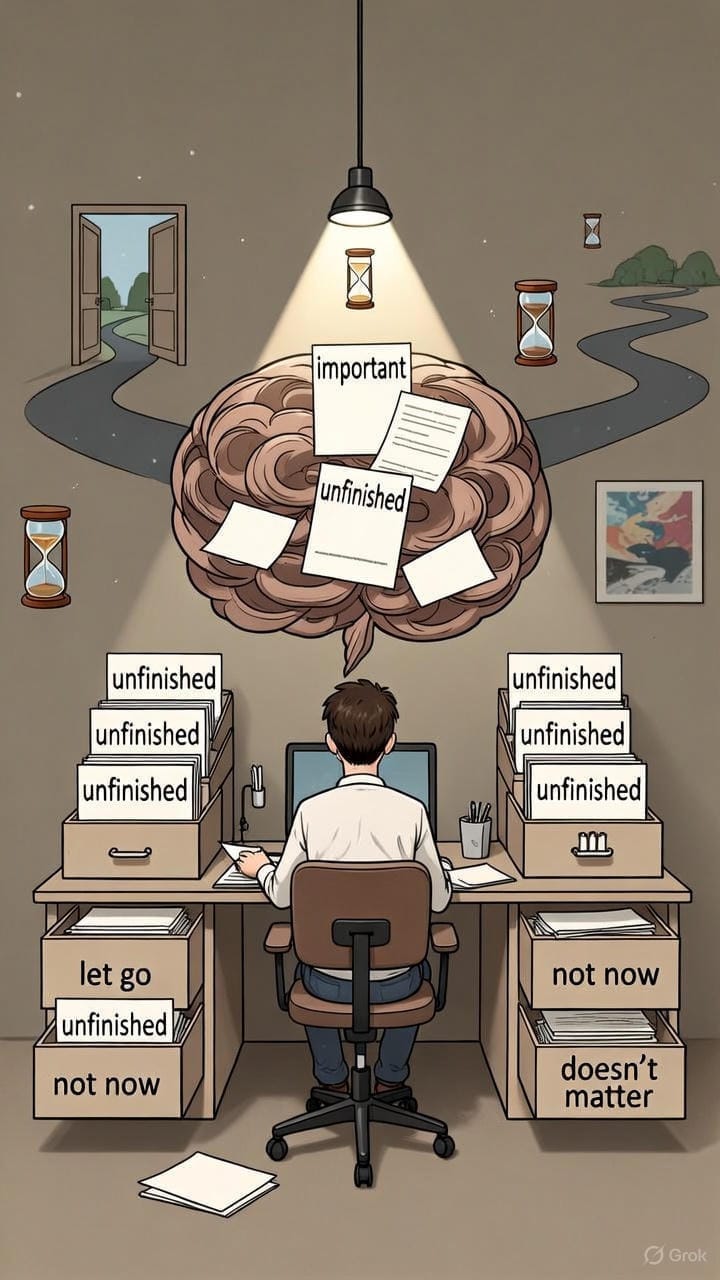
Think of your mind like a desk. If it’s covered with dozens of half-finished papers, you can’t focus on anything. It feels cluttered, overwhelming, and impossible to manage. But if you file away the things that don’t matter, the important work suddenly becomes clear. You can see what deserves your effort and what doesn’t.
Your mental life works the same way. The emotional weight of unfinished business isn’t about the tasks themselves. It’s about the clutter they create in your attention. When you hold onto everything, you lose the ability to prioritize. But when you choose what truly matters, the noise fades and your mind feels lighter.
The goal isn’t to close every loop. The goal is to live well with the ones that stay open.
That’s where clarity comes from. That’s where peace begins.
Get the latest Unfinished.